


Roaming allows drivers to charge electric vehicles at public charging stations via their eMobility service provider's (EMSP) network.
To facilitate roaming, EMSPs enter into agreements with charge point operators (CPOs) and implement a communication system based on open protocols.
Protocols are a set of rules that standardise communication between networks and software platforms. Roaming protocols support a range of functionalities, and, most importantly, authorisation. CPOs and EMSPs can also use protocols to exchange charge point and tariff information, as well as offer advanced features like app-based start and stop of charging sessions.
In the European EV market, four main roaming protocols are currently in use:
- OCPI
- OICP
- OCHP
- eMIP
- OCPP
What is OCPI?
The Open Charge Point Interface protocol (OCPI) was developed by eViolin, an association consisting of Dutch charge point operators, eMobility service providers and ElaadNL (a group of major Dutch grid operators). OCPI is currently managed and maintained by the EVRoaming Foundation.
The OCPI protocol supports a wide range of use cases, such as:
- Providing charge point information.
- Authorising charge sessions.
- Sharing tariff information.
- Enabling app-based charging.
OCPI supports both peer-to-peer (P2P) and roaming hub connections. In P2P roaming, CPOs and EMSPs have direct bilateral connections via which they exchange data. Meanwhile, in hub-based roaming, a charge point operator or mobility service provider can access many roaming partners via a single, standardised connection.
'OCPI is the only protocol with a smart charging module, allowing drivers to choose whether they want to charge as cheaply or as fast as possible or optimise for the use of green energy.'
While it took some time for OCPI to take off, it is now a widely used (roaming) protocol. OCPI is used worldwide and adopted by many companies and roaming hubs, such as GIREVE, Hubject and e-clearing.net. A common approach is to use it in a hybrid form for both peer-to-peer connections and in combination with roaming hubs.
Currently, OCPI is the most widely used roaming protocol in Europe thanks to its broad feature range and highly open system for further development.


What is OICP?
The Open Intercharge Protocol (OICP) was developed by Hubject, a group of German automotive and energy companies, in 2012. Along with OICP, Hubject also offers an ad-hoc payment solution and a contractual framework for EV roaming.
However, Hubject now also offers OCPI, as the hub joined the EVRoaming Foundation in September 2025.
The OICP protocol supports a range of use cases, such as:
- Roaming via the Hubject hub.
- Ad-hoc payments.
- Authorisations.
- Real-time exchange of charge point information.
- Billing and reservations.
Along with OCPI, OICP is one of the two roaming protocols that facilitate the exchange of signed meter data. Signed meter data confirms the amount of electricity provided to an EV during charging, and thereby helps charge point operators conform to German calibration law requirements (Eichrecht). This is invaluable to companies operating in the German market.
OICP connects hundreds of companies across Europe and is widely used in the DACH market.
| Features | OCPI | OICP | OCHP | eMIP |
|---|---|---|---|---|
| Hub roaming |  | | | |
| P2P roaming | | | | |
| Providing charge point information | | | | |
| Charge point search module | | |||
| Authorising charge sessions | | | | |
| Reservations | | | | |
| Remote start and stop | | | | |
| Providing session information | | | | |
| Ad-hoc payments | | |||
| Billing | | | | |
| Smart charging support | | |||
| Calibration law (Eichrecht) support | | | ||
| Platform monitoring | | | ||
| Communication | Real-time | Real-time | Asynchronous | Real-time |
Table 1: Comparison of roaming protocols
What is OCHP?
The Open Clearing House Protocol (OCHP) was developed by SmartLab Innovationsgesellschaft GmbH and ElaadNL, and is managed by the roaming hub e-clearing.net.
OCHP facilitates hub-based roaming with features like:
- Authorisation.
- Billing.
- Providing charge point and session information.
- Remote start and stop.
The extension OCHP-Direct allows CPOs and EMSPs to make use of the same functionality via a peer-to-peer connection.
OCHP relies mainly on asynchronous, as opposed to real-time, communication. For example, it creates so-called ‘white lists’ of users, instead of authenticating them in real-time based on information from the EMSP. This means that even if the roaming hub ever goes down, charge sessions would still work, as a single point of failure is avoided.


What is eMIP?
The eMobility Interoperation Protocol (eMIP) is designed and managed by GIREVE, an integrated platform founded by EDF, Renault, CNR, and Caisse des Dépôts. It is most widely used in France.
EMIP supports both roaming via the GIREVE platform and peer-to-peer connections, with functionalities including:
- Providing charge point and session information
- Authorisation
- Billing
- Platform monitoring
eMIP lets CPOs and EMSPs add any sort of data messages or identification methods, thus allowing new features to be implemented quickly without the need for 'repeat protocol' version updates.
Also, eMIP is the only protocol that supports a charge point search module, which allows EMSPs to retrieve a list of charge points located in a given geographic area and fulfil a set of charging criteria (e.g. connector type).
GreenFlux has developed a similar capability that allows EMSP customers to retrieve charge point information via our whitelabel ChargeAssist App and Charge Assist API.
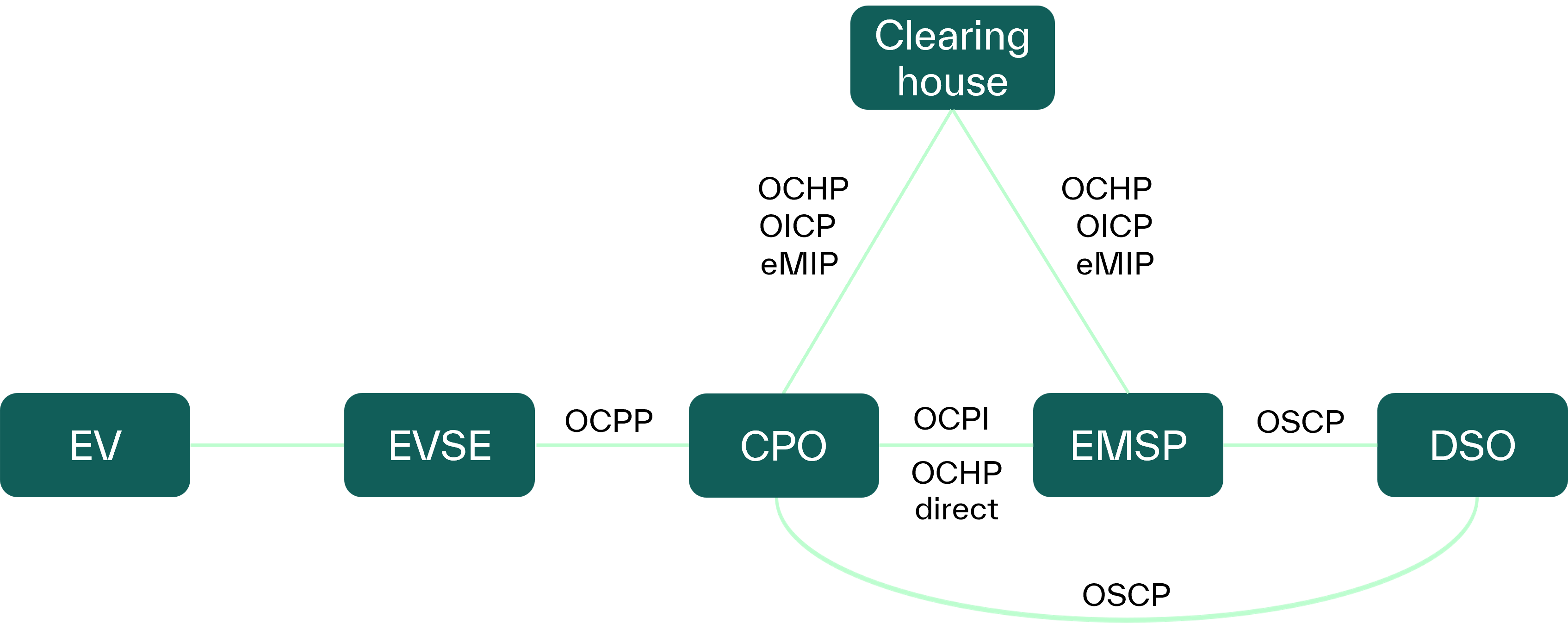

Figure 1. Visualisation of the EV roaming protocols OCPP, OCPI, OICP, OSCP, OCHP and eMIP. (EVSE = Electric Vehicle Supply Equipment, which are the chargers. DSO = Distribution System Operator, which is the grid operator.) (Source: EmobilitySimplified.com)
What is OCPP?
OCPP (Open Charge Point Protocol) is an open-source, global-standard communication protocol that enables physical EV charging stations (hardware) and charge point management systems (also known as CPMS, or EV charging software) to communicate with each other. It enables interoperability between different brands of hardware and software, preventing vendor lock-in and allowing remote, scalable, and intelligent management of charging stations.
OCPP was developed by ElaadNL in 2010 to support the installation and use of 10,000 chargers in the Netherlands. By opening it up to everyone, ElaadNL wanted to support the development of more and better EV charging infrastructure.
'The OCPP protocol enables the communication betweenm charge point and charge point management system.'
Communication between CPMS and charge point
While roaming protocols (OCPI, OICP, OCHP, eMIP) focus on communication between different market players (like a CPO and an eMSP), OCPP focuses on the communication within a single operator's network.
Think of it as the operating system for EV chargers. It allows a charge point operator to:
- Monitor status: Check whether a charger is available, occupied, or out of order in real time.
- Remote control: Start or stop a charging session remotely or reboot a hung charger.
- Smart charging: Send commands to the charger to limit the power output based on grid capacity.
- Firmware updates: Push security and feature updates to the hardware over-the-air.
Why OCPP matters for roaming
You cannot have effective roaming without a solid OCPP foundation. When a driver uses an eMSP app to start a session on a third-party network:
- The OCPI protocol (e.g., roaming) carries the authorisation request from the eMSP to the CPO's back end.
- The OCPP protocol then carries the 'Remote start' command from the CPO’s back end to the actual charging station.
Without OCPP, a CPO would be 'locked in' to a specific manufacturer’s proprietary software. By using OCPP, CPOs can mix and match hardware from different brands while keeping them all on a single management platform, like the GreenFlux CPMS. This flexibility is what allows large-scale roaming networks to remain scalable and cost-effective. What's more, GreenFlux's EV charging management software is hardware-agnostic, meaning that we support 851 of the most-used charging station brands and types.
In January 2025, OCPP 2.1 was released and is now the latest available release. It added a couple of new functionalities such as support for ISO 15118-20, bidirectional charging, battery swapping and new authorisation (payment) options.


GreenFlux's roaming offering
GreenFlux supports the OCPI, OICP and OCPP protocols to provide the best experience for charge point operators and mobility service providers. As e-clearing.net, Gireve, and Hubject all support OCPI, this means the GreenFlux platform supports all major roaming hubs without needing to support all protocols.
With our Roaming-as-a-Service packages, GreenFlux not only creates and maintains the technical connections required for roaming but also negotiates contracts and provides a settlement service to help manage this complex roaming ecosystem. This means new EMSP customers can instantly access a network of more than 200,000 charge stations, while new CPO clients can connect to nearly every charge card in Europe and beyond with the click of a button.


